Neural operators learn the map from the parameters of a PDE to its solution. Wavelets are localized in both space and frequency, so wavelet neural operators track fine patterns in how solutions depend on the parameters.
Methods and developments
Wavelet neural operator (WNO)
Here, we introduce the Wavelet Neural Operator (WNO) for learning the parametric mapping between input and output function spaces. The WNO blends conventional neural network integral kernels with wavelet transformation. WNO harnesses the superiority of wavelets in space-frequency localization of functions, enabling accurate tracking of patterns in the spatial domain and effective learning of functional mappings. Since the wavelets are localized in both time and space, as well as in frequency, WNO can provide high spatial and frequency resolution. This offers the learning of the finer details of the parametric dependencies in solving complex problems.
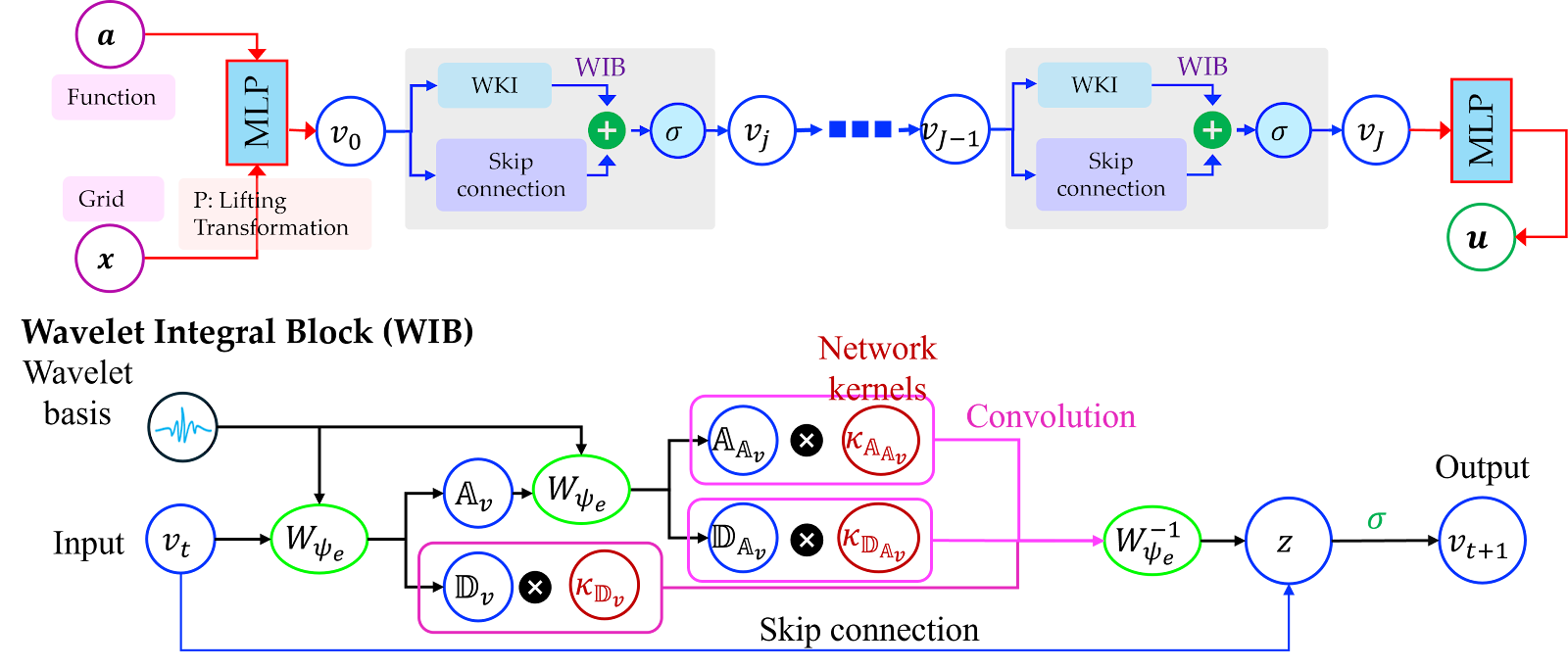
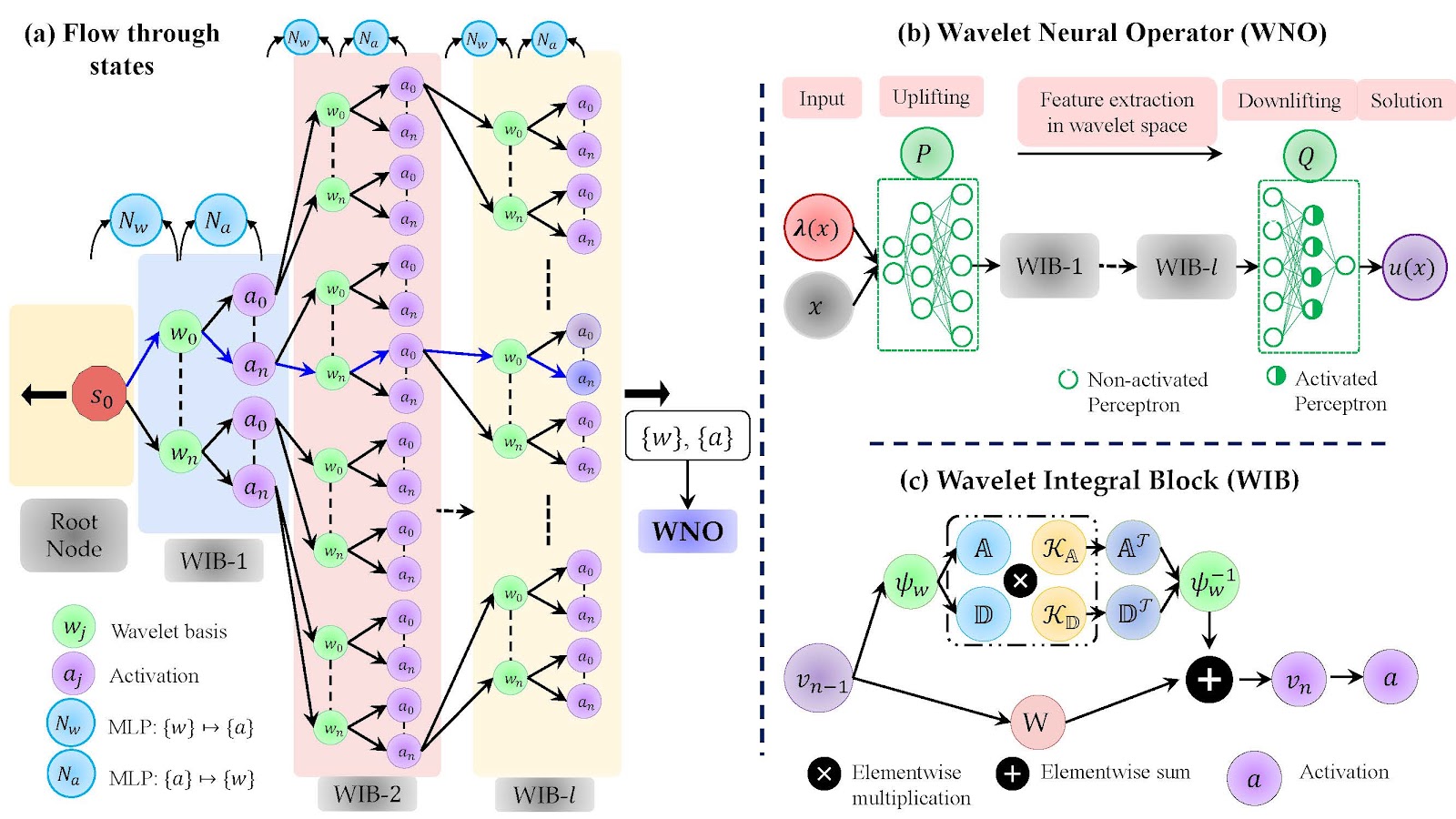
The WNO. An MLP lifts the input function and the grid, a chain of wavelet integral blocks (WIB) updates the features, and an MLP maps them to the output function. Inside a block, the input is wavelet-transformed, convolved with learned kernels for the approximate and detailed coefficients, transformed back, and added to a skip connection.
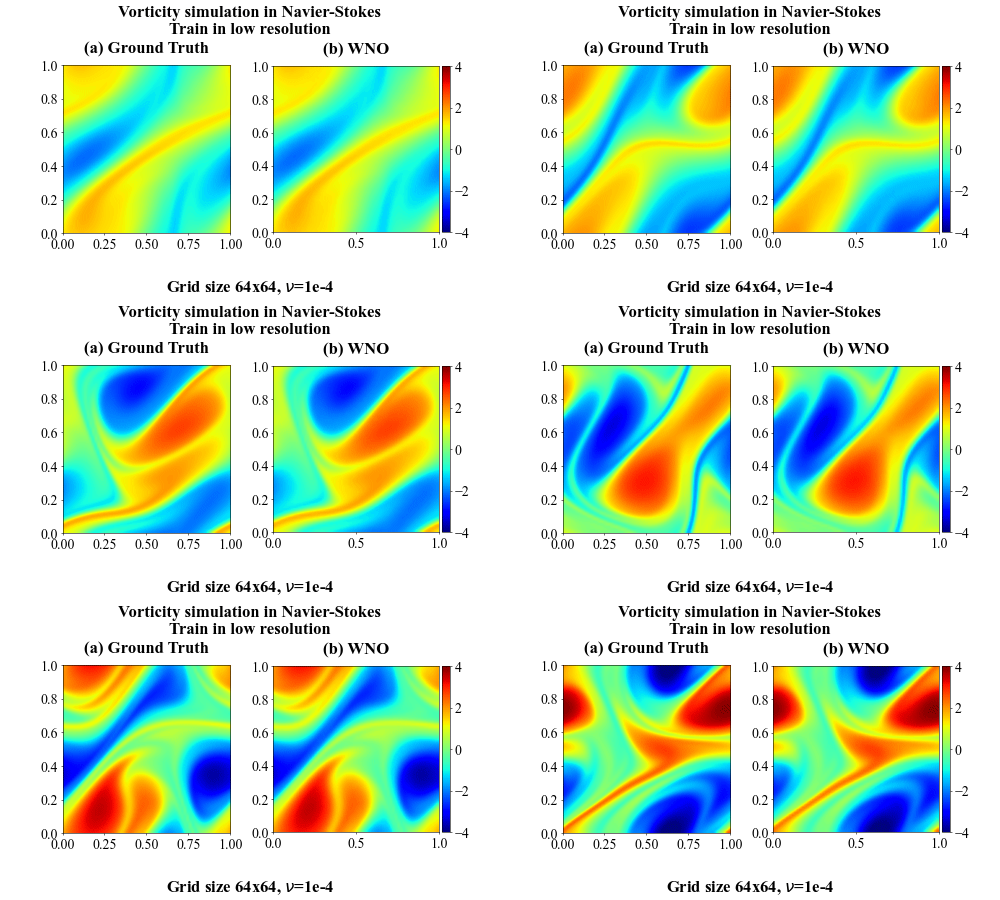
Prediction of the incompressible Navier–Stokes vorticity field on a 64 × 64 grid, with the model trained at this low resolution: ground truth against WNO.
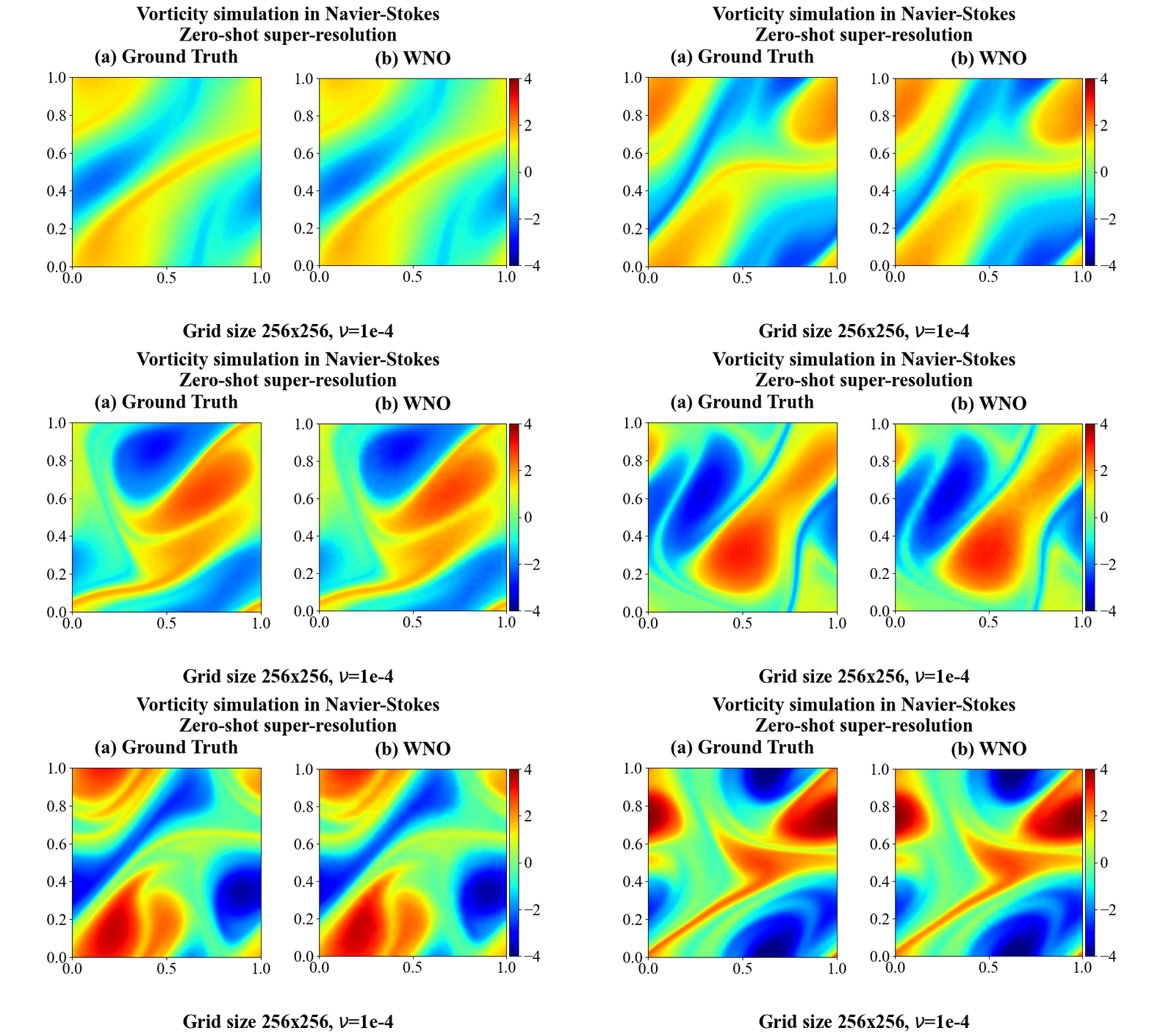
Zero-shot super-resolution of the Navier–Stokes vorticity field on a 256 × 256 grid: ground truth against WNO.
Prediction of the 24-hour activity of Cyclone Amphan from the previous 24 hours of wind-velocity data.
Physics-informed WNO (PIWNO)
Deep neural operators are recognized as an effective tool for learning solution operators of complex partial differential equations (PDEs). As compared to laborious analytical and computational tools, a single neural operator can predict solutions of PDEs for varying initial or boundary conditions and different inputs without repeated independent runs from scratch. The Wavelet Neural Operator (WNO) is one such operator that harnesses the advantage of time–frequency localization of wavelets to capture the manifolds in the spatial domain effectively. However, the data-hungry nature of the framework is a major shortcoming. Relying completely on conventional solvers for data generation and subsequently training operators with generated data leads to a time-consuming and challenging implementation of the operators in practical applications. We propose a physics-informed WNO for learning the solution operators of families of parametric PDEs without labeled training data.
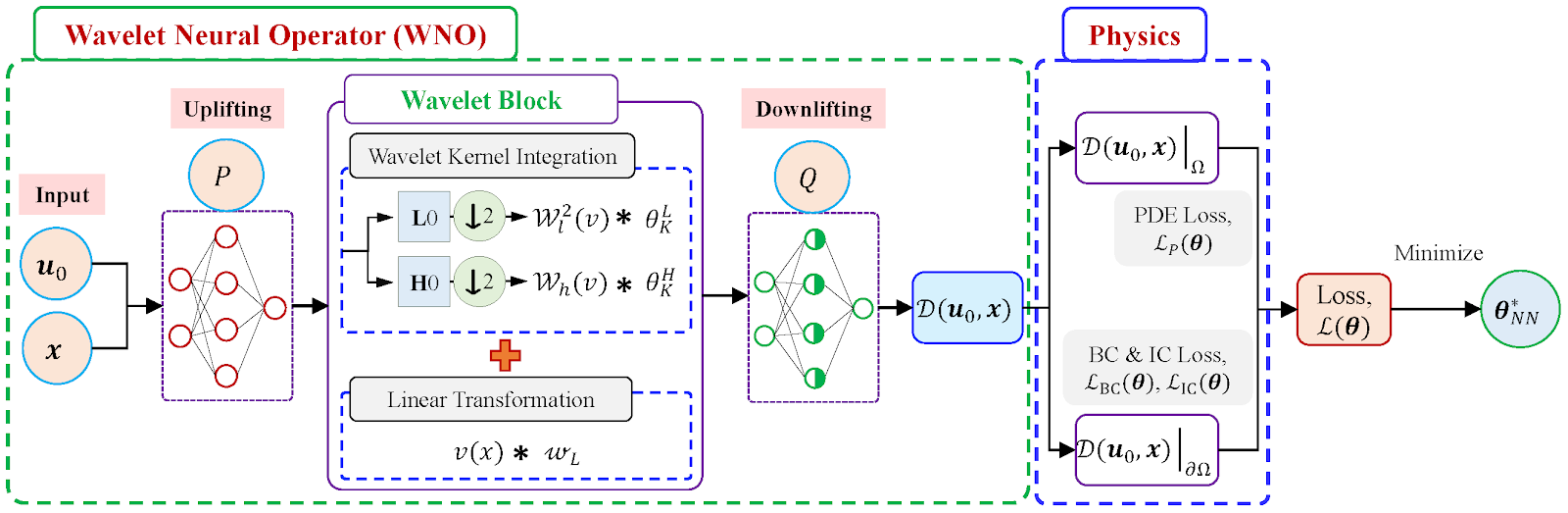
The PIWNO. The wavelet neural operator maps the input function and the coordinates to the solution. Instead of labeled data, a physics loss is minimized: the PDE residual inside the domain, plus the boundary and initial condition losses.
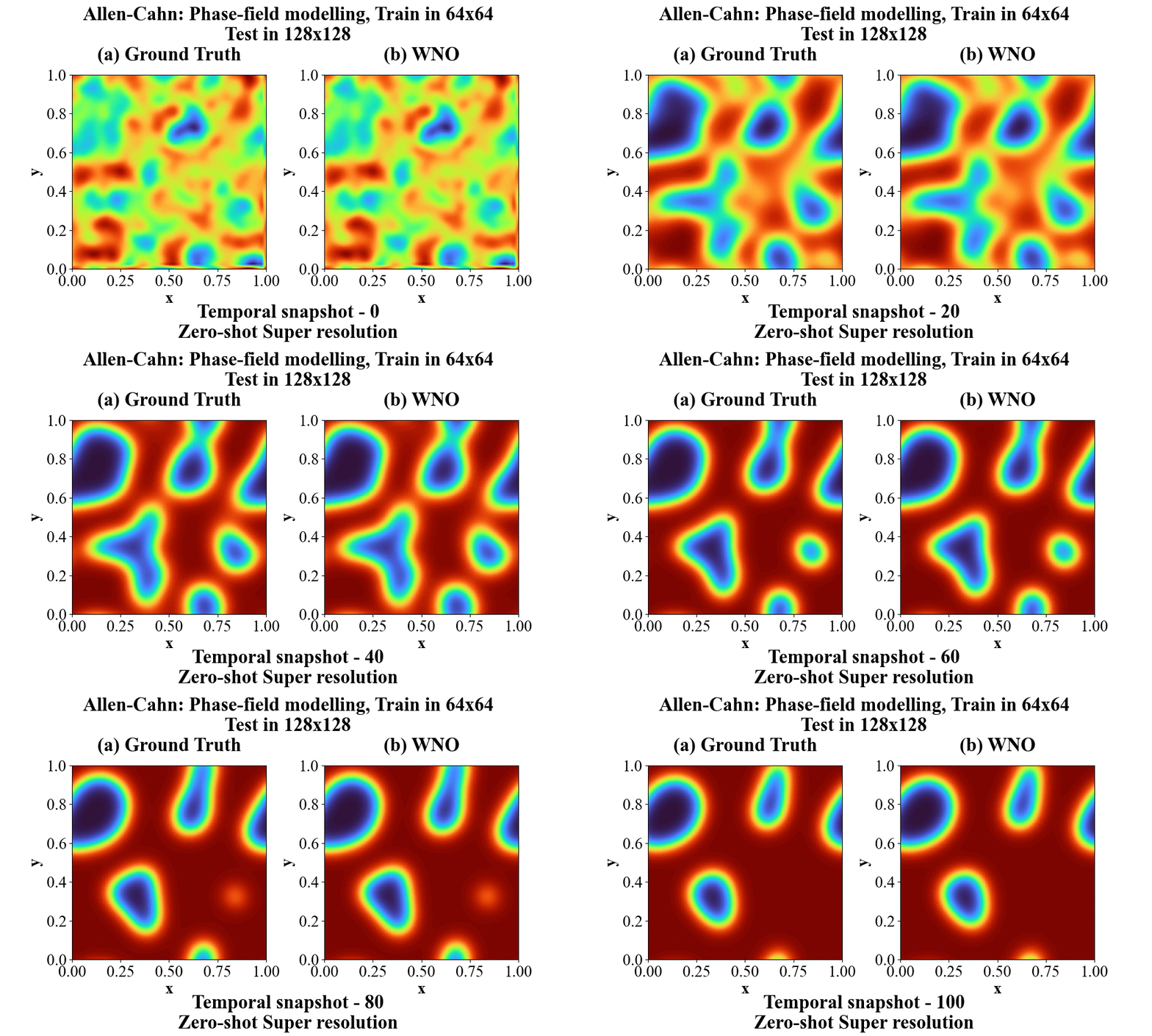
Allen–Cahn phase-field model. Trained on a 64 × 64 grid and tested zero-shot on 128 × 128: ground truth against the predicted field.
Multi-fidelity WNO (MFWNO)
Neural operators need a lot of high-fidelity (HF) data to train, and HF data is expensive: it comes from fine-grid simulations or physical experiments. Low-fidelity (LF) data, from coarse grids or simplified models, is cheap and easy to get in large amounts. The multi-fidelity WNO (MF-WNO) learns the HF solution operator from a large LF dataset and only a small HF dataset. It is used as a fast surrogate for reliability analysis of dynamical systems, where thousands of model evaluations are needed.
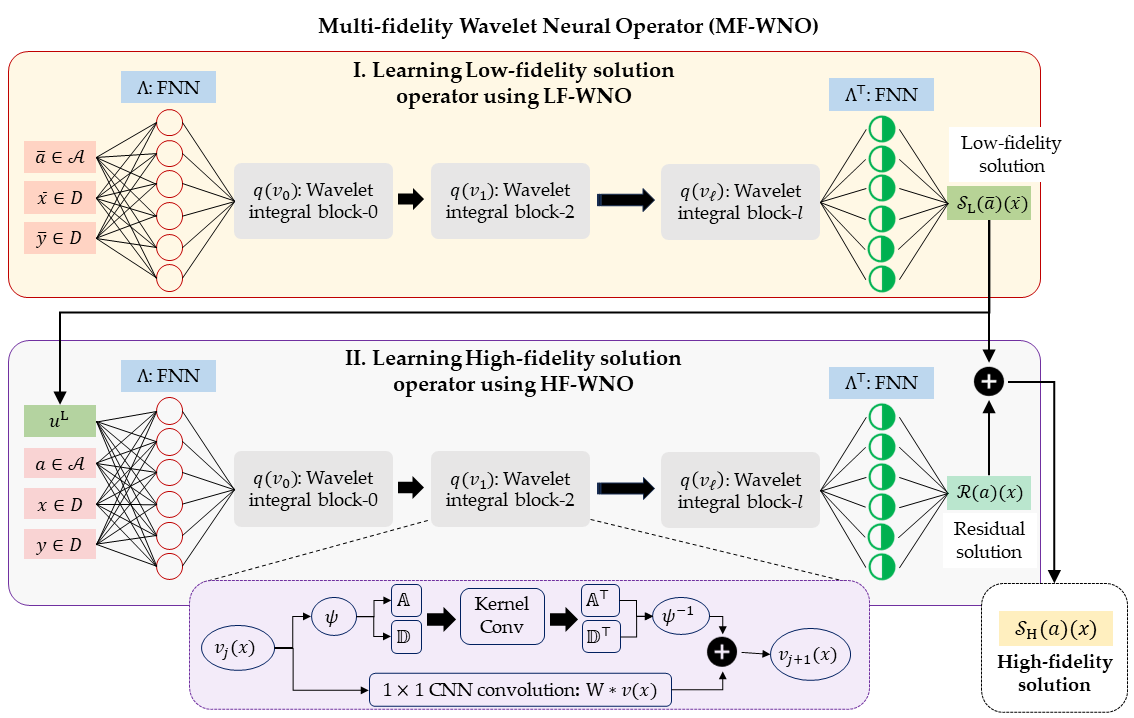
It works in two steps. First, a WNO is trained on the large LF dataset, or replaced by an LF solver if one is available. Second, a separate HF-WNO takes the HF input together with the LF solution, and learns only the residual, the difference between the HF and LF solutions. The HF prediction is the LF solution plus the learned residual. This is easier than learning the HF operator directly from a few samples, because the LF solution already carries the rough shape of the answer:
Here \(\mathcal S_H\) and \(\mathcal S_L\) are the HF and LF solution operators, \(\bar a\) is the LF input, and \(\mathcal R\) is the residual operator learned by the HF-WNO. The LF-WNO is not trained together with the HF-WNO: its output is only an extra input to the second network.
Once trained, the surrogate replaces the numerical solver in a Monte Carlo reliability analysis. The failure probability is the probability that a limit state function \(g\) falls below a threshold \(e_h\):
Here \(\boldsymbol\Theta\) holds the random inputs, and the indicator \(\mathbb I_{\Omega^f}\) is 1 for a failure and 0 otherwise. In practice, the surrogate is evaluated on thousands of random inputs and the fraction that fail is counted.
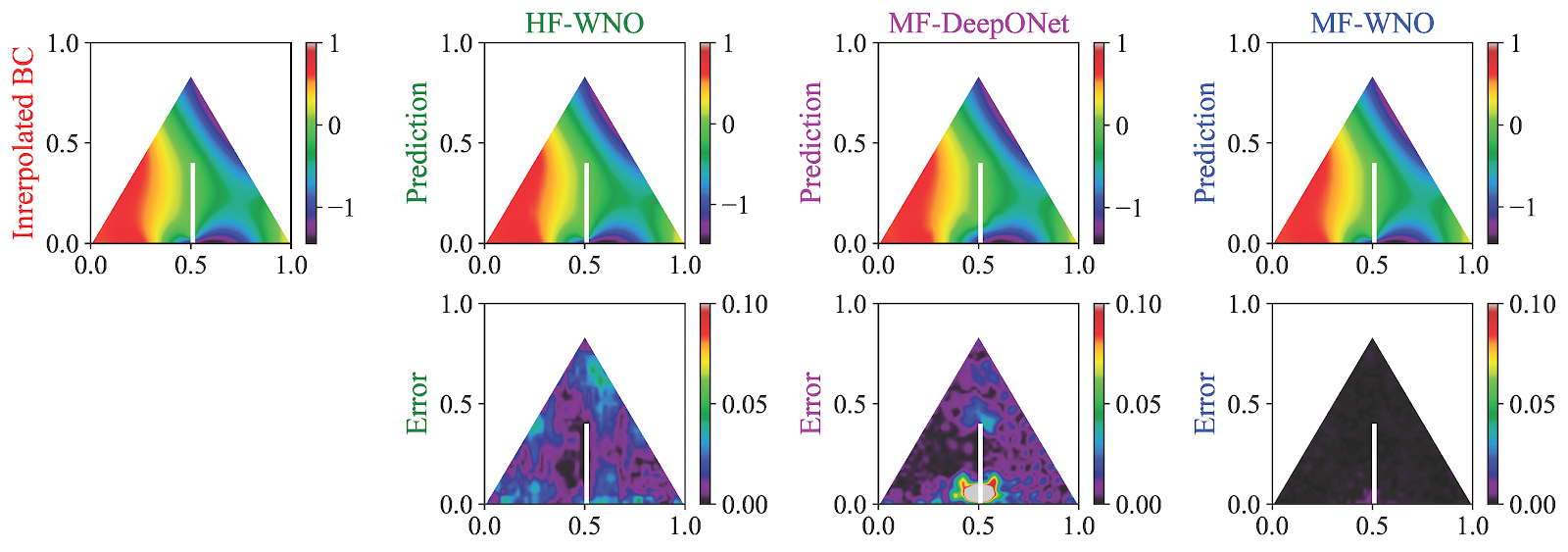
The paper tests the MF-WNO on a 1D Poisson equation, a 2D Darcy flow in a triangular domain with a notch, and the time-dependent 2D Allen–Cahn equation. It is compared with a WNO trained on HF data only and with a multi-fidelity DeepONet. On Poisson and Darcy, the MF-WNO has the lowest error at every training size. On Darcy, its failure probability matches the Monte Carlo value from the true solver (0.125) at every training size, while the other two do not. On Allen–Cahn with 200 training samples, its failure probability (0.28) is close to the Monte Carlo value (0.29).
The MF-WNO. (I) A WNO is trained on the large low-fidelity (LF) dataset. (II) A second WNO takes the high-fidelity (HF) input together with the LF solution and learns the residual. Adding the residual to the LF solution gives the HF solution. The inset shows a wavelet integral block.
Darcy flow in a triangular domain with a notch, for one boundary condition, with models trained on 50 samples. The input boundary condition is on the left. For HF-WNO, MF-DeepONet and MF-WNO, the top row is the predicted field and the bottom row is the error.
Neural combinatorial WNO (NCWNO)
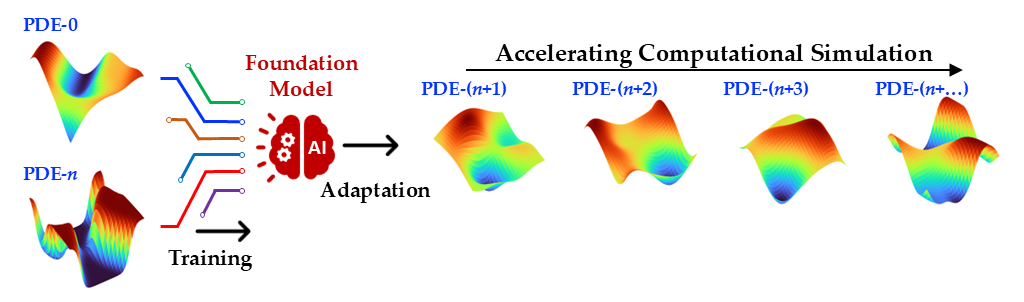
A scientific foundation model that learns many PDEs at once without catastrophic forgetting and adapts to unseen parametric PDEs.
A foundation model is trained once on a set of PDEs, then adapted to new PDEs to accelerate computational simulation.
We propose a generative flow-induced neural architecture search algorithm. The proposed approach devises simple feed-forward neural networks to learn stochastic policies to generate sequences of architecture hyperparameters such that the generated states are in proportion with the reward from the terminal state. We demonstrate the efficacy of the proposed search algorithm on the wavelet neural operator (WNO), where we learn a policy to generate a sequence of hyperparameters like wavelet basis and activation operators for wavelet integral blocks. While the trajectory of the generated wavelet basis and activation sequence is cast as flow, the policy is learned by minimizing the flow violation between each state in the trajectory and maximizing the reward from the terminal state.
The flow-induced architecture search. (a) Flow through states: starting from a root node, two small MLPs generate, block by block, the wavelet basis (green) and the activation (purple) of each wavelet integral block (WIB). The generated sequence defines the WNO. (b) The wavelet neural operator. (c) The wavelet integral block.
Applications
Elastography
Elastography is an imaging modality where an inverse problem is solved to extract the elastic properties of tissues and subsequently mapped to anatomical images for diagnostic purposes. In the present work, we propose a wavelet neural operator-based approach for correctly learning the non-linear mapping of elastic properties directly from measured displacement field data.
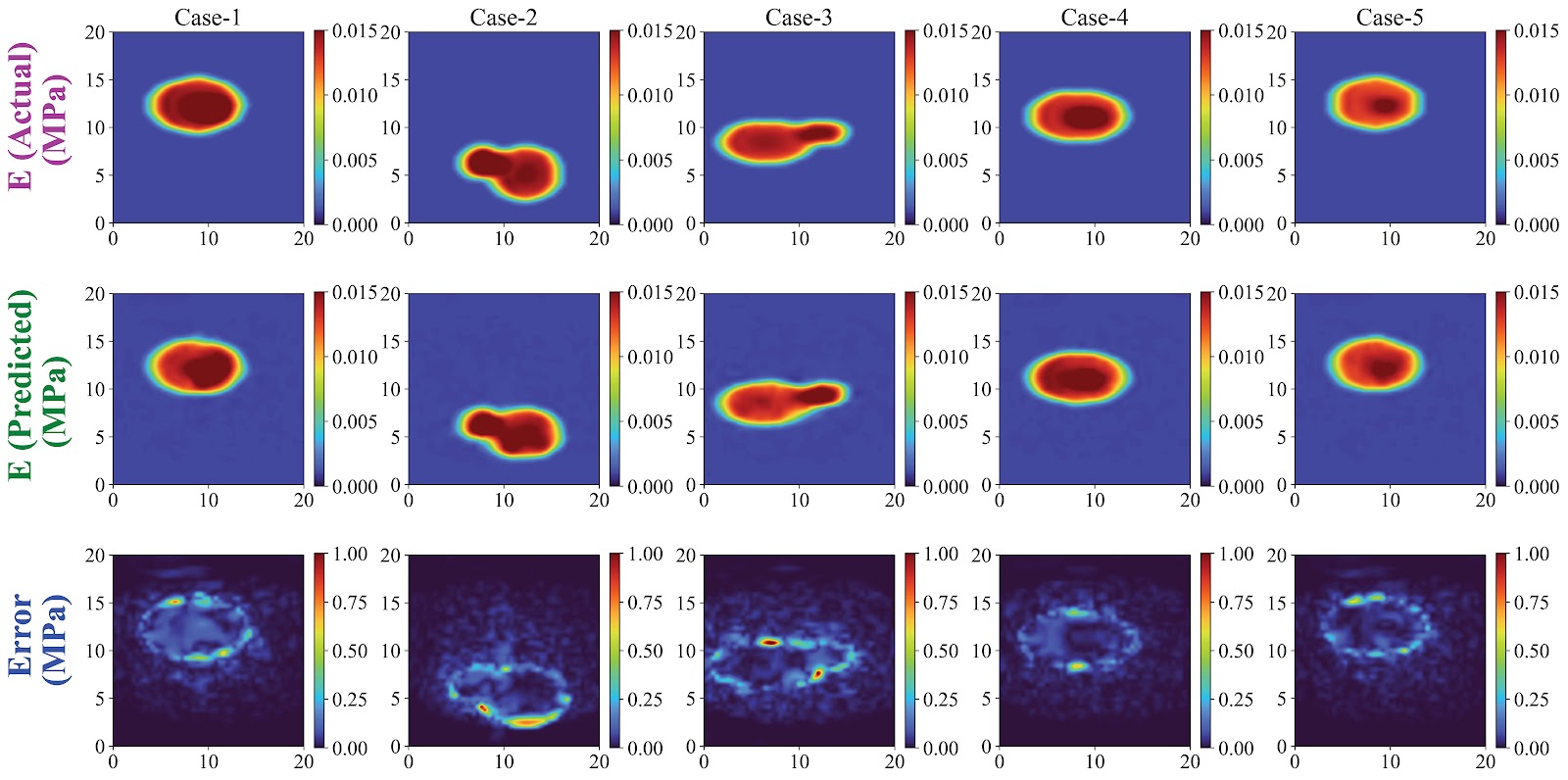
The proposed framework learns the underlying operator behind the elastic mapping and thus can map any displacement data from a family to the elastic properties. The displacement fields are first uplifted to a high-dimensional space using a fully connected neural network. On the lifted data, certain iterations are performed using wavelet neural blocks. The mapping between the displacement and the elasticity using wavelets is unique and remains stable during training. The proposed framework is tested on several artificially fabricated numerical examples, including a benign-cum-malignant tumor prediction problem.
Test cases of the benign and malignant tumor classes. The reference (actual) elasticity is in the top row, the WNO prediction in the middle row, and the error in the bottom row. All axes are in mm.
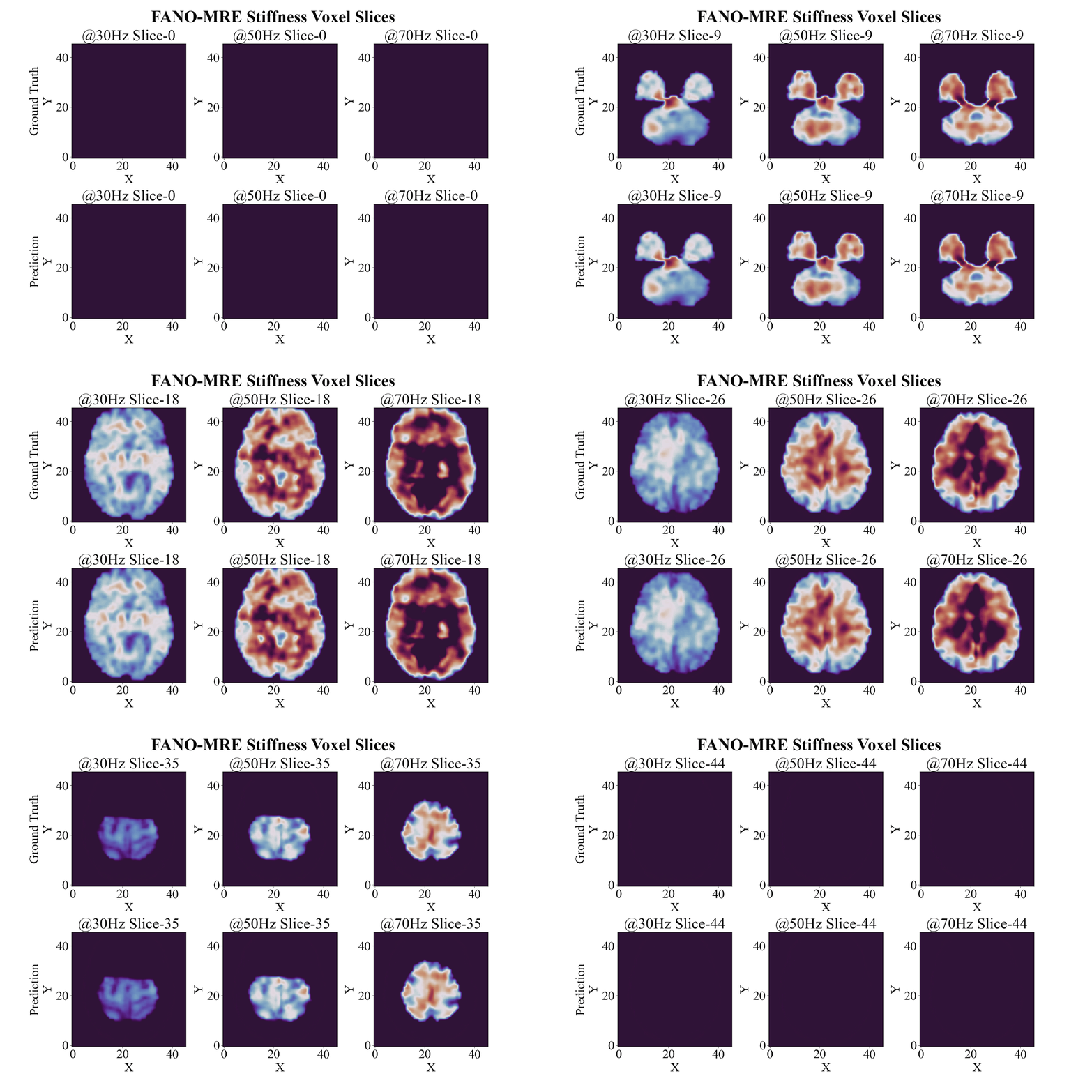
Shear stiffness prediction on the MRE dataset with a single wavelet expert (FWNO-MRE). Stiffness slices at the three excitation frequencies, 30, 50 and 70 Hz, for a single test subject: the ground truth from nonlinear inversion (NLI) in the top row and the prediction in the bottom row.
Generative adversarial WNO
A generative adversarial wavelet neural operator for fault detection and isolation in multivariate time-series data.